Macaw Parrot Guide: Species, Origin & Care 2026
Macaw Parrot Guide: Species, Origin, Behaviour and Care
Macaws are the birds that make people stop and stare, whether that is in a rainforest canopy or someone’s living room. Before you fall for those colours, it helps to actually understand what you would be bringing home. This guide covers what a macaw is, where the species come from, how they behave, and how to keep one healthy. If you are further along and want pricing and buying advice, that lives in our companion guide, Macaw Parrot Price and Buying Guide 2026.
What Is a Macaw Parrot?
A macaw is a large, long-tailed parrot native to the Americas, part of a group scientists call New World parrots. There are around 17 living species, ranging from small mini macaws barely a foot long to the hyacinth macaw, which stretches close to a metre from beak to tail tip.
Macaws belong to the same broad family as cockatoos, African greys and Amazon parrots, but they stand apart because of their size, their long tapering tails and their powerful curved beaks built for cracking hard nuts. In the wild, they live across Mexico, Central America and South America, favouring rainforest and savannah habitats.
Macaws also rank among the most intelligent birds kept as pets. Their brains are proportionally large for their body size, and in the wild they solve problems such as working out how to open tough palm nuts or navigating complex social groups. That intelligence is a double-edged sword for owners: it makes macaws fascinating companions, but it also means a bored macaw finds its own entertainment, often at the expense of your furniture.
Macaw Parrot vs Other Parrots
New owners often compare macaws with African greys, Amazon parrots, and cockatoos before deciding. Each bird brings something different to the table.
Macaw vs African grey
African greys are generally regarded as the best talkers among parrots, with a genuine gift for mimicking words in context. Macaws can learn to talk, but their vocabulary tends to be smaller and less clear. Where macaws pull ahead is size, colour and boldness of personality.
Macaw vs Amazon parrot
Amazon parrots are stockier and shorter-tailed, and many are excellent singers and talkers with strong, sometimes fiery personalities. Macaws are larger overall, need more space, and tend to be more physically demonstrative once they trust you.
Macaw vs cockatoo
Cockatoos are famous for extreme neediness and a tendency towards separation-related screaming when left alone. Macaws are also social and vocal, but many owners find them slightly more independent than a cockatoo, provided their enrichment needs are met.
None of these comparisons crown a single winner. The right bird depends on how much noise, space, and one-on-one time you can genuinely offer.
Where Do Macaw Parrots Come From?
Macaws are native to the tropical regions of the Americas. Depending on the species, wild populations are found in:
- Brazil, home to some of the richest macaw diversity on the planet, including the Pantanal wetlands favoured by hyacinth macaws
- Peru, where several species inhabit lowland rainforest
- Bolivia, home to critically endangered species such as the blue-throated macaw
- Central America, including parts of Mexico, where scarlet macaws still range through remaining forest
Many species have lost significant territory to deforestation, agriculture and the pet trade, which is why several macaws, including the hyacinth and blue-throated macaw, now carry threatened or vulnerable conservation status.
Natural Habitat of Macaws
In the wild, macaws live high in the rainforest canopy, using their strong feet and beaks to move through branches almost like a third limb. They are highly social, typically travelling and feeding in pairs or small flocks, and their loud calls carry for long distances through dense forest, helping birds stay in contact with their flock.
Nesting happens in natural tree cavities, often the same cavity reused year after year by a breeding pair. Because suitable nesting trees take decades to mature, habitat loss hits macaw breeding success particularly hard, even in areas where the adult birds themselves are not directly threatened.
This flock-based, cavity-nesting lifestyle explains a lot about captive macaw behaviour. A pet macaw still carries the instincts of a flock animal, which is part of why they bond so intensely with their human household and why isolation affects them so heavily.
Types of Macaw Parrots
Blue and Gold Macaw
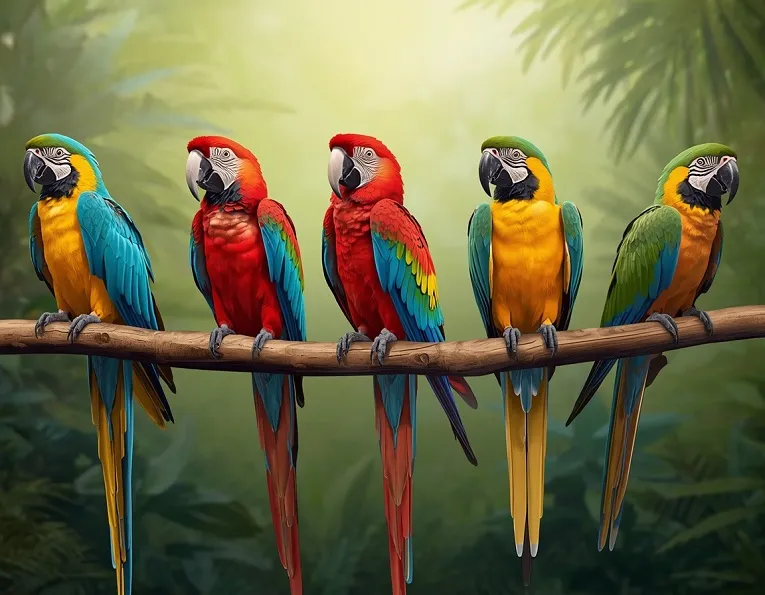
One of the most recognisable macaws, with a bright blue back and wings and a golden yellow chest. Blue and gold macaws are intelligent, sociable and often described as one of the more even-tempered large macaw species, which makes them a common choice for first-time large parrot owners.
Scarlet Macaw
Vivid red, yellow and blue plumage with a bare white face makes the scarlet macaw instantly recognisable. Scarlet macaws are playful and energetic, though many owners describe them as more strong-willed and occasionally moody compared to the blue and gold macaw.
Green-Winged Macaw
Often confused with the scarlet macaw at a glance, the green-winged macaw has a deep red body with a distinctive band of green across the wing, alongside blue flight feathers. Frequently nicknamed the gentle giant of the macaw world, it tends to have a calmer, more affectionate temperament than its size might suggest.
Hyacinth Macaw
The largest parrot species on earth, entirely cobalt blue with a bright yellow ring around the eyes. Hyacinth macaws are known as gentle giants too, generally calmer than smaller macaw species, but their size, rarity, and specialist dietary needs make them one of the most expensive and demanding birds to keep.
Military Macaw
Olive green with patches of red on the forehead, the military macaw is medium to large in size and known for being playful and social. It is generally considered one of the more affordable large macaw species, without sacrificing much of the intelligence or personality that draws people to macaws in the first place.
Mini Macaws
This is the gap most macaw articles miss. Species such as the Hahn’s macaw and the severe macaw are true macaws, just built on a smaller scale, often 30 to 40 centimetres long rather than 80 to 100. Mini macaws bring much of the personality and intelligence of their larger cousins in a body that needs less space, which makes them worth serious consideration for anyone drawn to macaws but limited on space.
Rare Macaw Colours Explained
A few terms cause genuine confusion online, so it is worth clearing them up.
Blue Macaw Parrot
Blue macaw parrot is not one specific species. It is often used loosely to describe the hyacinth macaw, the Spix’s macaw, or the blue-throated macaw, three entirely different birds that all happen to carry heavy blue colouring.
White Macaw Parrot
A white macaw parrot does not really exist as a distinct macaw species. What people are usually picturing is either a white cockatoo, a different genus entirely, or a rare genetic colour mutation in a macaw species that would not be reliably reproduced or commercially available.
Rainbow Macaw Parrot
Rainbow macaw parrot almost always refers to a hybrid, most commonly the Catalina macaw, a cross between a scarlet and a blue and gold macaw. Hybrids like this are the product of selective breeding by aviculturists rather than a wild species, and while striking, they raise separate ethical questions around crossbreeding purely for colour.
Macaw Parrot Size (Small to Giant Species)
Macaw size varies more than most people expect. Mini macaws such as the Hahn’s macaw measure around 30 centimetres and weigh a few hundred grams, similar to a small conure. Standard large macaws, including the blue and gold and scarlet macaw, typically measure 80 to 90 centimetres including the tail. At the top end, the hyacinth macaw reaches close to a metre in length with a wingspan over 1.2 metres, roughly the wingspan of a large bird of prey.
That wingspan matters practically. A cage or aviary needs to allow a macaw to fully stretch and flap without hitting the bars, which is why cage sizing scales dramatically between mini and large macaw species.
Macaw Colours & Physical Traits
Macaw plumage runs through nearly every colour in the spectrum: deep blues, golden yellows, scarlet reds and forest greens, often combined on a single bird. Most species carry an area of bare, sometimes feather-lined, white or pale skin around the eyes, which becomes more flushed pink when the bird is excited.
Their beaks are the other defining feature. Built from keratin over a bony core, a macaw’s beak generates enormous crushing force, strong enough to crack Brazil nuts and macadamia nuts that would defeat a human hand. This strength is essential for their natural diet, but it also means a macaw bite, even a playful one, needs to be taken seriously.
Macaw Parrot Lifespan
Macaw lifespan depends heavily on species and size. As a general guide:
| Species | Typical lifespan in captivity |
|---|---|
| Mini macaws (Hahn’s, severe) | 20 to 40 years |
| Blue and gold macaw | 50 to 60 years |
| Scarlet macaw | 40 to 50 years |
| Green-winged macaw | Over 50 years |
| Military macaw | 55 to 70 years |
| Hyacinth macaw | 50 years in the wild, often 60 to 75 in captivity |
Some large macaws have been documented living into their eighties or nineties under exceptional care, though this is unusual rather than typical. The practical takeaway is simple: a macaw is likely to outlive the relationship you plan around it, which is why rehoming clauses and long-term care planning matter more with this bird than with almost any other common pet.
How Intelligent Are Macaws?
Macaws consistently rank among the most intelligent parrot species. In the wild, they solve genuinely complex problems, working out which nuts are worth the effort to crack and using their beak and foot together almost like a tool.
Problem-solving ability
Captive macaws can learn to work latches, solve foraging puzzles and remember multi-step routines, which is why enrichment toys designed for macaws tend to be more mechanically complex than those for smaller birds.
Emotional bonding
Macaws form strong attachments, often to one or two specific people in a household. This bond is genuine and rewarding, but it can also tip into possessiveness or jealousy towards other family members if not managed with consistent, shared socialisation from an early age.
Memory strength
Macaws remember routines, people and even specific negative experiences for years. A macaw that had a frightening experience with a particular object or person as a young bird may carry that wariness long into adulthood, which is part of why gentle, patient handling early on pays off for decades.
Macaw Parrot Behaviour
Macaws behave like the flock animals they are in the wild. They crave company, communicate constantly through body language and vocalisation, and rarely thrive when left alone for long stretches.
Social flock animals
A pet macaw effectively treats its household as its flock. It wants to be near you, involved in what you are doing, and included rather than isolated in another room.
Loud vocal communication
Macaws are not quiet birds. Wild macaw calls are designed to carry through dense rainforest, and that volume does not switch off indoors. Expect loud contact calls, particularly around dawn and dusk, regardless of how well socialised the bird is.
Attention-seeking behaviour
When under-stimulated, macaws escalate. This can mean louder calling, chewing on furniture, or feather-damaging behaviour. It is rarely about being difficult and almost always about an unmet need for interaction or mental stimulation.
Do Macaws Talk?
Macaws can talk, but speech is not their strongest suit compared with African greys, which are widely considered the clearest talkers among parrots. Macaws that do learn to speak typically pick up a modest vocabulary of individual words and short phrases rather than the extensive, context-aware speech some African greys develop.
Training potential
With consistent, positive reinforcement training, most macaws can learn basic words, whistles, and simple tricks. Younger birds generally pick up speech more readily than adults, and one-on-one repetition tends to work better than passive exposure to speech in the background.
Are Macaws Friendly Pets?
Yes, when properly socialised, macaws can be deeply affectionate, playful companions that actively seek out physical closeness and interaction.
Bonding behaviour
A well-socialised macaw will often want to be held, preened, or simply perched near its favourite person for long stretches. Many owners describe the bond as closer to that of a dog than a typical bird.
Human attachment level
That same intensity has a flip side. Macaws can become singularly attached to one person and wary or even aggressive towards others, particularly if only one household member handles the bird regularly. Rotating who feeds, trains, and interacts with the macaw from an early age helps prevent this narrowing of trust.
Macaw Parrot Care Guide
Housing & Cage Requirements
Large macaws need a cage that allows a full wing stretch without touching the bars in any direction, which in practice means a minimum floor size of around 75 by 120 centimetres and a height of at least 150 centimetres for the biggest species. Mini macaws can manage in a smaller cage, roughly 75 by 50 centimetres, but still need daily time outside it.
Enrichment is not optional. Rotating chew toys, foraging puzzles and sturdy perches of varying texture and diameter keep a macaw’s mind and beak occupied. Without this, that same energy tends to redirect towards your skirting boards, remote control, or its own feathers.
Macaw Diet & Nutrition
A balanced macaw diet typically centres on a high-quality formulated pellet, supplemented with fresh vegetables, a smaller amount of fruit and, for larger species particularly, a modest allowance of unsalted nuts, which mirrors their naturally high-fat wild diet.
Some everyday foods are genuinely dangerous. Avocado, chocolate, caffeine, alcohol, onion, and the seeds and pits of many fruits are all toxic to macaws and should never be offered, even as an occasional treat.
Grooming Needs
Routine grooming for a macaw covers three areas. Nail trimming keeps claws from overgrowing or catching, though many active macaws with varied perch textures naturally wear their nails down. Beak care is largely self-managing in a bird with plenty of hard chew toys and nuts to gnaw, though an avian vet should check for overgrowth or abnormal ridging at annual visits. Feather health depends on diet, humidity, and mental stimulation as much as bathing, so regular misting or shallow bathing opportunities support healthy plumage.
Common Macaw Health Problems
Feather plucking
This is one of the most common issues owners encounter, and it is rarely simple. Underlying causes range from boredom and inadequate enrichment through to genuine medical problems such as skin infections, nutritional deficiencies, or hormonal changes. Any sudden feather plucking deserves an avian vet visit rather than an assumption that it is purely behavioural.
Psittacine Beak and Feather Disease (PBFD)
This is a viral condition that damages feathers, beak, and the immune system. PBFD is far more common in Old World parrots such as cockatoos and African greys than in macaws, which are less frequently affected, though it has been documented in macaws and should still be on a vet’s radar if abnormal feather or beak growth appears.
Proventricular Dilatation Disease (PDD)
Sometimes called macaw wasting disease because it was first identified in this species, PDD affects the digestive tract, causing regurgitation, weight loss, and muscle wasting. It has no cure, though supportive treatment can help manage symptoms and improve quality of life. Diagnosis usually involves a combination of clinical signs, imaging, and specialist testing by an avian vet.
How to Keep a Macaw Healthy
Annual, or ideally more frequent, checkups with a vet who specifically treats birds catch problems long before they become visible to an untrained eye. Avian vets check weight trends, beak and nail condition, and can run bloodwork to catch organ issues early, since birds are skilled at masking illness until it is advanced.
Mental stimulation matters just as much as physical health for a macaw. A bird given daily foraging challenges, regular out-of-cage time, and consistent social contact is far less likely to develop the feather-damaging or destructive behaviours that often bring owners to a vet in the first place. Physical and psychological health are genuinely inseparable in this species.
Frequently Asked Questions
What is the lifespan of a macaw parrot?
It depends on species and size. Mini macaws typically live 20 to 40 years, while large macaws such as the blue and gold or hyacinth macaw often live 50 to 70 years with good care.
Are macaws good pets for beginners?
Generally not. Their size, noise, longevity, and emotional needs make them a demanding first bird. Many experienced owners recommend starting with a smaller, less intensive parrot species first.
Which macaw is the friendliest?
Individual personality varies, but the green-winged macaw and hyacinth macaw are frequently described as gentle giants, often calmer and more affectionate than their size suggests.
Do macaws talk like African greys?
Not typically. Macaws can learn words and short phrases, but African greys are generally regarded as clearer, more prolific talkers.
Where do macaw parrots come from?
Macaws are native to the tropical Americas, including Brazil, Peru, Bolivia and parts of Central America and Mexico.
How big do macaw parrots get?
Size ranges from around 30 centimetres in mini macaw species to close to a metre in the hyacinth macaw, the largest parrot species in the world.
Can macaws live with other pets?
With careful, gradual introductions, some macaws coexist peacefully with cats or dogs, though supervision is essential given the risk in both directions: a macaw’s beak can injure a smaller pet, and a larger dog can seriously harm a bird.
If you are weighing up whether a macaw fits your life and budget, our companion article covers real-world pricing, ongoing costs, and how to buy safely: Macaw Parrot Price and Buying Guide 2026.